
Practicing Supply Chain Decisions as Part of Enterprise Strategy

Context

In courses focused on supply chain management and operations, the Green Business Lab allows participants to examine how supply chain considerations shape, and are shaped by, broader business decisions related to product design, marketing, technology, innovation, and workforce management, particularly under conditions of disruption, safety risk, and sustainability pressure.

What participants do

Participants work as an executive team responsible for running the entire company. While making enterprise-level decisions across functions, teams view the business through a supply chain lens, addressing challenges such as sourcing risk, supply chain disruption, safety and compliance issues, and end-to-end resilience alongside cost, environmental impact, labor practices, and stakeholder expectations.

What participants practice

Through iterative decision cycles, participants practice:

  • Integrating supply chain risk, safety, and resilience considerations into enterprise strategy
  • Evaluating trade-offs across cost, reliability, sustainability, and innovation
  • Assessing how supply chain disruptions affect product design, marketing commitments, and workforce decisions
  • Managing uncertainty related to suppliers, logistics, and regulatory compliance
  • Communicating supply chain risks, responses, and trade-offs to stakeholders and the Board

Closing

Lens-specific debrief questions help participants connect supply chain decisions to broader enterprise performance, risk management, and long-term strategic priorities.

Participants learn about supply chain decisions.

Working together, participants practice skills by integrating perspectives, aligning priorities, and discussing decisions within a shared strategic context.

  • Teams use the marketing business simulation game.
    Recognize the importance of working with stakeholders to ensure transparency, buy-in, and improvement.
  • Track supply chain strategy in the sustainability simulation game.
    Analyze supply chain activities against financial, environmental, and social metrics to improve decision-making.
  • Leadership strategy and supply chain are important in the simulation game.
    Modify product development to reduce cost and environmental and social impact.
  • Tasks for supply chain in the simulation game.
    Summarize supply chain risk and mitigation strategies.
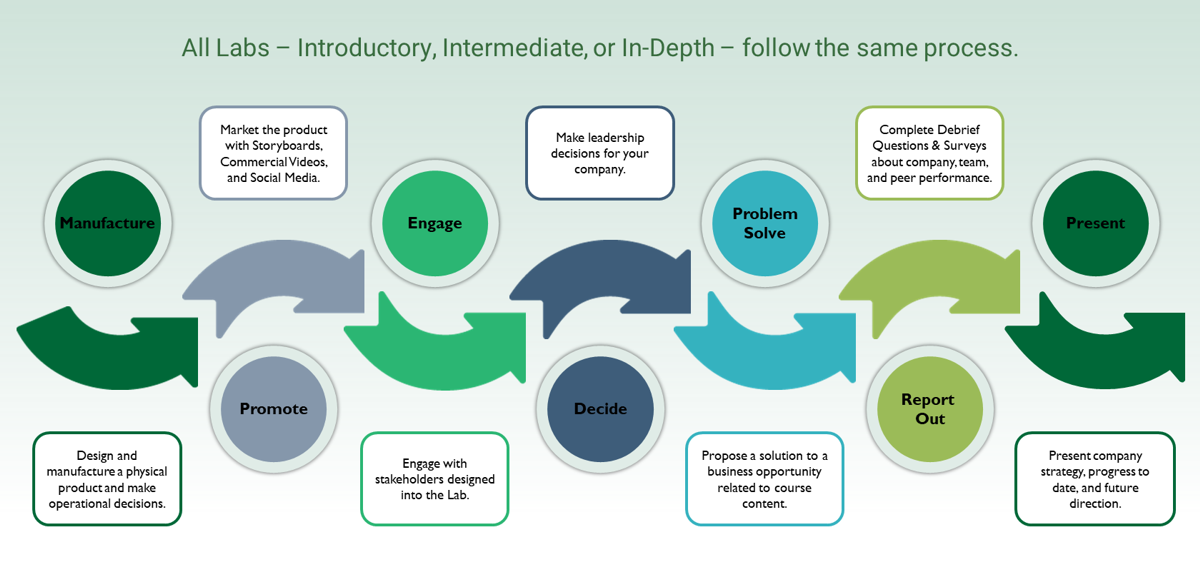
Diagram of the sustainability simulation game work process.
View the "Process" graphic
Description of the sustainability simulation game work flow.
Download the "Process" PDF

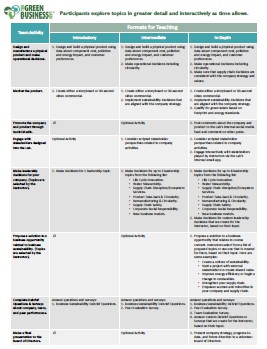
The following table describes in detail 3 Lab formats: Event, Short-format Module, and Multi-Week Integration.

Labs with longer formats have more options for available features, content, and interactivity.

View this page as a PDF

Team Activity
Formats for Supply Chain
Event Short-Format Module Multi-Week Integration
Design and manufacture a product and make operational decisions. 1.Select a design and make operational decisions for a product using data about component cost, pollution and energy impact, and customer preferences.

1.Select a design and make operational decisions for a product using data about component cost, pollution and energy impact, and customer preferences.

2. Make operational decisions that are aligned with the company strategy.

1.Select a design and make operational decisions for a product using data about component cost, pollution and energy impact, and customer preferences.

2. Make operational decisions that are aligned with the company strategy.

3. Integrate sustainability into essential supply chain decisions.

Market the product. 1. Create either a storyboard or 30-second video commercial.

1. Create either a storyboard or 30-second video commercial.

2. Implement marketing decisions that are aligned with the company strategy.

1. Create either a storyboard or 30-second video commercial.

2. Implement marketing decisions that are aligned with the company strategy.

3. Make sure that supply chain performance aligns with company quality standards to earn labels and certifications.

Promote the company and product through Social Media. Not Available. This is an optional activity described in the In-Depth format. 1. Post comments about the company and product to the Lab’s internal Social Media feed, and comment on the other posts.
Engage with stakeholders designed into the Lab. This is an optional activity described in the Intermediate format. 1. Consider scripted stakeholder perspectives related to company activities.

1. Consider scripted stakeholder perspectives related to company activities.

2. Engage interactively with stakeholders played by the instructor via the Lab’s internal email app (optional).

Make leadership decisions for your company.

(The instructor selects the topics. For the In-Depth format, we can also create custom topics based on instructor input.)

1. Make decisions for 1 leadership topic.

1. Make decisions for up to 3 leadership topics from the following list:

  • Life Cycle Innovation.
  • Water Stewardship.
  • Supply Chain Disruption and Ecosystem Services.
  • Product Take-back.
  • Remanufacturing and Circularity.
  • Supply Chain Safety.
  • Corporate Social Responsibility.
  • Product as a Service.

1. Make decisions for up to 8 leadership topics from the following list:

  • Life Cycle Innovation.
  • Water Stewardship.
  • Supply Chain Disruption and Ecosystem Services.
  • Product Take-back.
  • Remanufacturing and Circularity.
  • Supply Chain Safety.
  • Corporate Social Responsibility.
  • Product as a Service.

2. Make decisions for custom topics (optional).

Propose a solution to a business opportunity related to supply chain sustainability.


(The instructor selects the topics. For the In-Depth format, we can also create custom topics based on instructor input.)

Not Available. This is an optional activity described in the In-Depth format.

1. Propose a solution to a business opportunity that relates to course content. Here are some examples:

  • Implement a supplier Scorecard.
  • Design a vendor management program.
  • Develop a joint project with suppliers to reduce their footprint.
  • Improve equality and social responsibility in your supply chain.
  • Implement a recall process for damaged or tainted products.

2. Propose a solution to custom topics (optional).


Complete Debrief Questions & Surveys about company, team, and peer performance.

(For the In-Depth format, we can create custom surveys based on instructor input.)

Answer questions and surveys:

1. Supply Chain Sustainability Debrief Questions.

Answer questions and surveys:

1. Supply Chain Sustainability Debrief Questions.

2. Peer Evaluation Survey.

Answer questions and surveys:

1. Supply Chain Sustainability Debrief Questions.

2. Peer Evaluation Survey.

3. Team Evaluation Survey.

4. Answer custom Debrief Questions or Surveys that we create for the instructor, based on their input (optional).

Make a final presentation to the Board of Directors. Not Available. This is an optional activity described in the In-Depth format. 1. Present company strategy, progress-to-date, and future direction to a volunteer Board of Directors.

Participants explore topics in greater detail and interactively as time allows.

View this page as a PDF
Data that describes the sustainability simulation game.

Focus Areas

Use in virtual, in-person, or blended classes.

Use in virtual, in-person, or blended classes.

The Green Business Lab logo for the simulation.

Enter your email to subscribe to

The GBL Business Sustainability Blog

We're happy to have you join us! Subscribe & receive our latest posts in your inbox. We respect your privacy & never share your information. You can unsubscribe at any time.

Thank you for subscribing!