
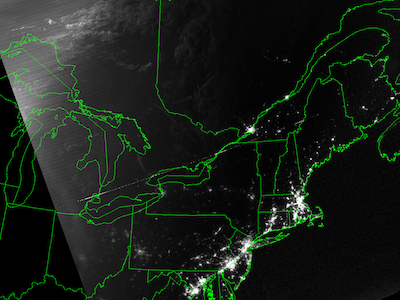
Just after four in the afternoon on August 14, 2003, fifty million people across parts of eight US states and Ontario suddenly lost power. The failure took less than ten minutes to spread from a software glitch at FirstEnergy’s Ohio control room to the entire northeastern grid. The blackout lasted up to two days in some areas, and longer in some Canadian locations. Economic losses totaled between four and ten billion dollars, depending on how the count was conducted.
The immediate causes were small. A software bug in FirstEnergy’s grid management system meant operators did not see warning signals as transmission lines began to overload. Untrimmed trees in Ohio sagged into transmission lines as the lines heated under increasing load. Communications failures between grid operators meant the event was already in progress before anyone understood what was happening.
What the blackout revealed was something bigger than the technical failures that caused it. The systems business depended on were more fragile than executives had assumed. Hospitals went to backup generators. Financial markets closed. Transportation stopped. Manufacturing halted. Food distribution was disrupted. For a period of hours to days, the operational continuity of millions of businesses depended on whether their suppliers had backup power and how long that backup would last.
Before August 2003, environmental performance and sustainability were largely about emissions, waste, and resource use. Resilience was largely a concept managed by IT departments and disaster recovery planners, not yet a strategic concern that most boards or sustainability functions considered systematically. The blackout began to change that. Within months, board-level conversations across multiple industries added questions. Where are our single points of failure? What is our exposure to grid failure? Which of our suppliers can operate without us telling them how, and for how long? What happens to our customers if our systems go down for two days?
Insurance markets began to reassess business interruption coverage. Companies in sectors most exposed to grid failure began investing in distributed generation, microgrids, and redundant infrastructure. The migration toward decentralized and resilient power architectures, already underway, accelerated across data center, healthcare, and financial services operations.
The blackout also exposed a broader concern that had been building in infrastructure analysis for years. The North American grid had been built for the demand patterns of the 1960s and 1970s and was operating beyond its original design tolerances. By the early 2000s, climate scientists were beginning to warn that heat waves, intensified storms, and demand spikes would add new stresses to aging grids. The 2003 blackout was not caused by climate change. It demonstrated what climate-stressed grids could do under increasing pressure.
The concern that emerged from 2003 expanded steadily through the years that followed. Hurricane Katrina made landfall just over two years later, in August 2005, exposing supply chain concentration as another form of single point of failure. The 2008 financial crisis showed how risk could cascade across interconnected institutions and markets. The 2011 Fukushima disaster disrupted supply chains across the automotive, electronics, and other sectors that depended on specialized suppliers in the affected region. COVID-19 in 2020 collapsed assumptions about logistics, labor, and product availability that companies had treated as permanent. Each event added new dimensions to what resilience meant. Each event made the concern larger and more central to corporate strategy.
By 2026, resilience appears as its own section in major sustainability frameworks. The Task Force on Climate-related Financial Disclosures includes physical risk assessment. The European Union’s Corporate Sustainability Reporting Directive requires disclosure of climate adaptation and resilience strategy. The International Sustainability Standards Board’s IFRS S2 standard requires similar disclosures for climate-related physical risks.
The business case lesson follows. Concerns that appear at the edge of business attention can become central faster than executives expect. Resilience moved from an IT concern to a strategic priority in less than a decade. Companies that built capability early had the infrastructure in place by the time the rest of the field caught up. Companies that treated resilience as someone else’s problem found themselves having to build from scratch when the next disruption hit. The concern that does not yet exist in your strategy may be the one that defines it five years from now.
This is the kind of judgment the Green Business Lab is built to develop, the ability to see where today’s edge concern becomes tomorrow’s strategy, and to make the call before the disruption forces it.