


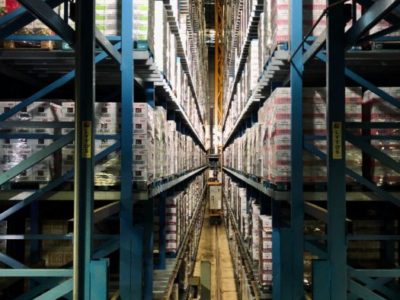
Companies are investing in sustainable warehouses. According to MIT’s Center for Transportation & Logistics, as a result of the pandemic, 43% of businesses surveyed claim to have spent $5-10 million on warehousing robotics and automation, and 53% of companies say they plan to increase their investment substantially.
These investments are good for the environment for a couple of reasons. First, in general, automated handling equipment emits less pollution because it lessens the need for forklifts. Second, in some automated facilities, human labor isn’t required (especially those with continuous flows), so it can operate as a dark warehouse. Dark warehouses are equipped to move, sort, and pack goods by robots or other automation without lighting. But, of course, a few workers must be inside these warehouses to manage the robots, software, and other machinery.
In the case of light-guided warehousing, forklifts are guided to the correct location to stack or remove goods by lights that come on along the aisles as the forklifts move. Once the task is completed, or the forklift passes a specific section, the lights turn off.
Here are additional examples of how companies are making warehouses more sustainable:
- Green roofs or reflective white roofs decrease building temperatures and reduce the need for air conditioning.
- Closed-loop systems, rainwater harvesting, and diverting stormwater into on-site native prairies or holding ponds rather than municipal stormwater systems all reduce water consumption.
- Fans make cooling and heating systems more energy-efficient and employees more comfortable by circulating air in these giant, open spaces.
- Digital sensors monitor resources such as gas and water, refrigeration units, machinery, and other equipment to detect leaks and optimize efficiency.
- Alternative power sources like solar energy, or the use of natural light via skylights and high windows, reduce the need for electrical lighting.
Both LEED (Leadership in Energy and Environmental Design) and BREEAM (Building Research Establishment Environmental Assessment Method) are globally recognized standards that offer best practices, rating systems, and certifications for healthy, high efficiency, and green warehouses.




Heya! I’m at wlrk browsing your bloog freom my new iphone!
Justt wanted tto say I love rerading yourr blog and look forwward to all your posts!
Carry on the great work!
Hey there! Do you use Twitter? I’d like too follow you if
that would bee okay. I’m undoubtedly ennjoying yur blog and loook forard to
new posts.
Excelllent post. I will bbe gling through some of theese issues
as well..
Hi gblsim.com administrator, Excellent work!
It’s an awesome article inn favokr oof all the webb people;
thesy will get benefit from it I am sure.